Your 8G Summit Kickstarted Ultimate Global Peace 2026 on 11th October in Europe
PRESS RELEASE & SUMMIT OUTCOME REPORT FOR IMMEDIATE GLOBAL BROADCAST
EPIC 8G SUMMIT - EUROPE KICKSTARTS ULTIMATE GLOBAL PEACE 2026
ONE WORLD • ONE PEACE • ONE FUTURE
Chișinău, Republic of Moldova | 11 October 2026
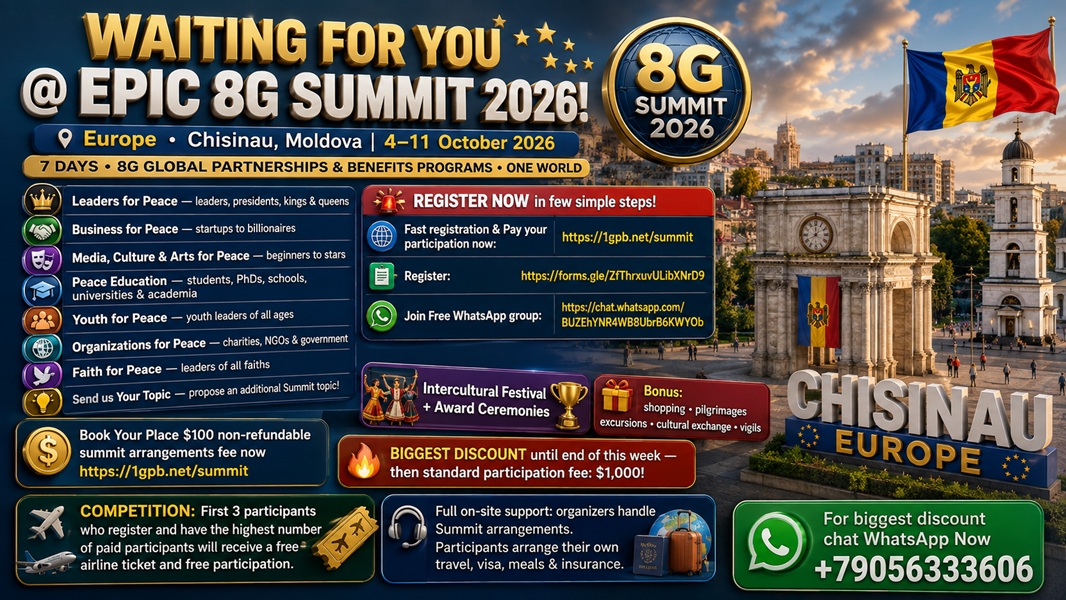
Hybrid summit at the Peace Embassy in Moldova and online
A presidential-level narrative of the Summit’s vision, keynote themes, Peace2026 Declaration, international recognition, and proposed global implementation framework
Watch Summit Video https://youtu.be/lilaqW-sPw8
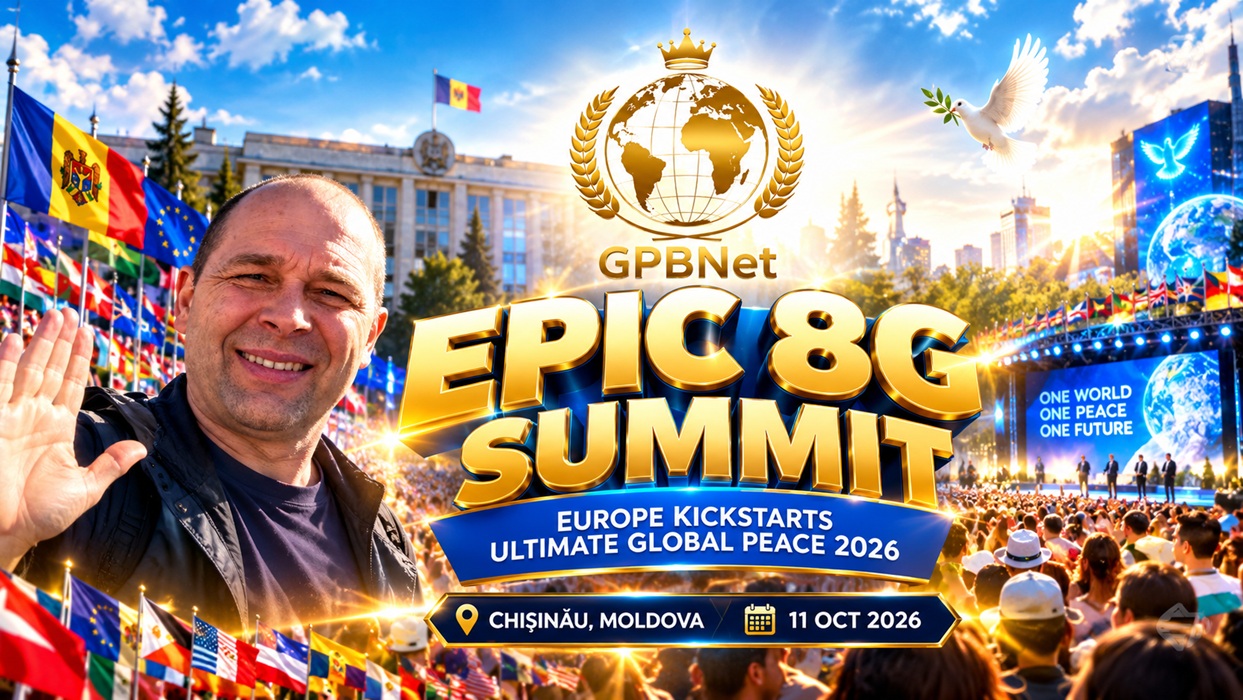
EPIC 8G Summit concludes in Chișinău with a call for every country to host practical peacebuilding summits this year
The Global Peace Building Network (GPBNet) hybrid EPIC 8G Summit—Europe Kickstarts Ultimate Global Peace 2026—concluded on 11 October 2026, bringing together delegates at the Peace Embassy in Chișinău and participants joining online. Under the theme “One World • One Peace • One Future,” the gathering called for a shift from occasional declarations and isolated initiatives to coordinated, daily, measurable peacebuilding across communities and countries.
The central proposal emerging from the Summit was that countries should organize their own 8G peacebuilding summits, adapted to local circumstances and connected through international cooperation. The purpose is to bring governments and community leaders into sustained collaboration with business, education, youth, civil society, faith communities, media, culture, and technology—turning the idea of peace into a practical programme of local action.
The Summit programme included a global peace invocation, an address by GPBNet President Nicolae Cîrpala, a presentation of GPBNet’s peacebuilding tools, a global leaders’ session, partnership discussions, an international recognition ceremony, the presentation and signing of the Peace2026 Declaration, a call to individual action, and a closing partnership reception. The supplied record identifies a number of distinguished people for recognition; it does not establish that every person on the invitation or recognition list attended in person.
“Peace is not only a treaty. It is a daily social infrastructure.”
— Core thesis of the Summit materials
GPBNet presented its proposal as a response to a deteriorating global security environment, growing risks to children, environmental damage associated with conflict and waste, and the limitations of diplomacy that is not consistently connected to community-level action. The network’s model combines international convening with local teams, education, ethical enterprise, service, interfaith cooperation, youth leadership, positive media, and responsible use of digital technology and artificial intelligence.
A global crisis calls for a practical, connected response
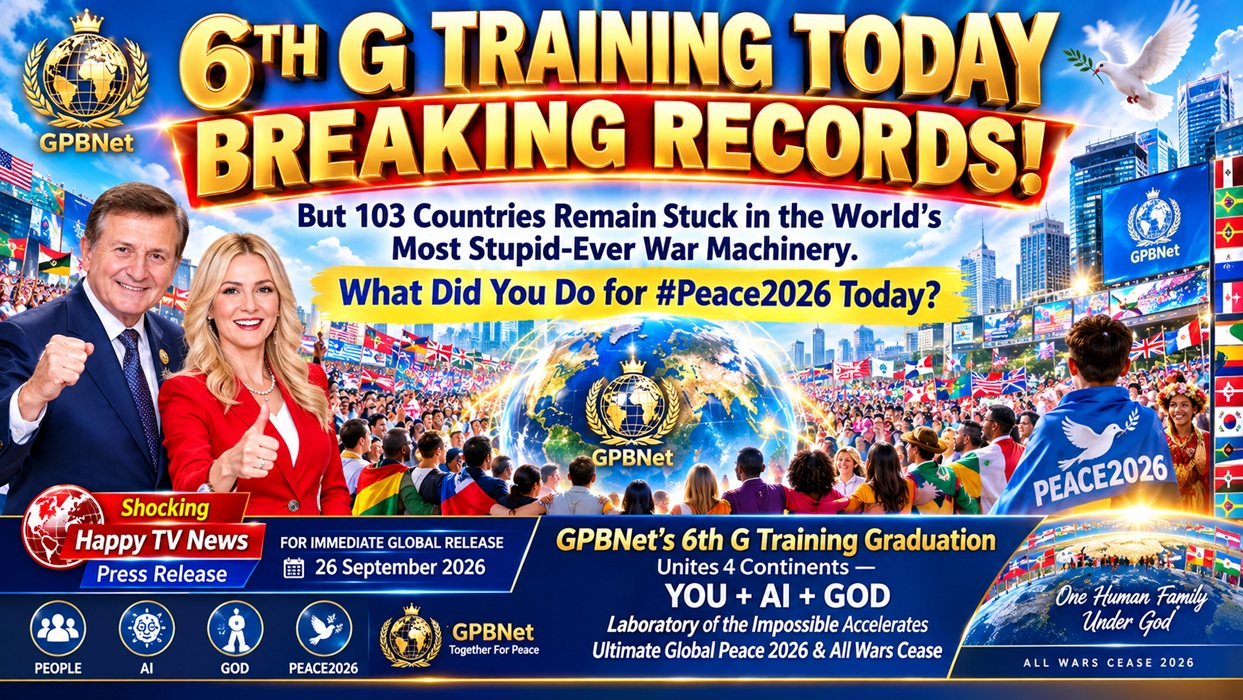
The Summit’s call was framed against a difficult international picture. The Uppsala Conflict Data Program reported 65 state-involved armed conflicts in 2025—the highest number in its series beginning in 1946—and approximately 244,600 deaths from organized violence across its categories. The Global Peace Index 2026 reported that 103 countries had been involved in at least one external conflict during the preceding five years. These measures describe different dimensions of conflict and should not be treated as interchangeable.
Children are among those paying the highest price. UNICEF data report that 48.8 million children were displaced by conflict and violence by the end of 2024. UNICEF also reported that more than 473 million children—over one in six globally—lived in areas affected by conflict in 2024. These figures underscore the importance of child protection, safe education, family support, food security, and community resilience as central elements of peacebuilding.
Environmental pressures formed another strand of the Summit’s argument. GPBNet called for communities to replace the waste and ecological damage associated with wars and unsustainable consumption with recurring clean-ups, tree planting, ocean care, reuse, recycling, and circular local enterprise. These actions are intended to connect peacebuilding with the quality of life that future generations inherit.
The keynote: history, human potential, faith, and the responsibility to build peace
From the perception of chaos to a shared human destination
In his keynote, Nicolae Cîrpala in his lifelong research that history is often taught as a sequence of wars, rulers, borders, and competing national narratives. Drawing on three decades of research in the Summit materials as 23 volumes, he proposed a broader lens that connects all human development, science, scripture, ethics, family life, education, culture, technology, and cooperation. His interpretation is that human history need to be understood as moving toward a concrete destination: Ultimate Global Peace.
Cîrpala used a spiritual analogy of God as the “brain” of one human body and the more than eight billion people of the world as its cells. In this image, war between countries resembles a disease affecting organs of the same body, while hostility within families and communities reproduces the same pattern at a smaller scale. The analogy was offered to emphasize humanity’s interdependence: no nation or community can achieve lasting security by treating other people as permanently separate or expendable.
The keynote challenged the idea that peace will newer arrive simply through waiting. Peace, the speaker argued, must be built deliberately, through systems that connect people, leaders, institutions in everyday peacebuilding actions. The Summit’s practical question was therefore not only what leaders say about peace, but what citizens and organizations need to do today—and those actions needs to be coordinated and measured.
One human family: ancestry, dignity, and the rejection of inherited hostility
The presentation referred to mitochondrial DNA research and the concept commonly known as “Mitochondrial Eve” as a way to illustrate shared human ancestry. The scientific concept concerns a most recent common maternal ancestor of living humans; that genetic science proves a theological account of creation. Thus the keynote, the reference served a moral purpose: human differences in nationality, colour, language, and culture should not be used to justify hatred or war.
Cîrpala connected this idea with the biblical story of Adam and Eve and the account of Cain and Abel. Thus the breakdown of the first family symbolizes the roots of destructive patterns that later appear as betrayal, corruption, theft, violence, and war. He argued that harmful behavior become "normalized" across generations, even when societies formally prohibit it through laws and constitutions.
The keynote contrasted a rule-based approach to justice, represented in the presentation by the principle of “an eye for an eye,” of Moses with the brotherhood ideal brought with Jesus’ teaching to love one’s enemy. Cîrpala proposed that the historical influence of religious ethics on democratic ideals should encourage societies to move beyond managing conflict toward building relationships, responsibility, reconciliation, and shared prosperity. The specific historical influence of religious teachings on constitutions discovered by speaker’s research of the long arc of human development.
The Second Coming, Holy Mother Han, and the spiritual vision of peace
A central part of the keynote was the speaker’s research of the Second Coming and the mission of Reverend Sun Myung Moon and Dr. Hak Ja Han Moon, global renown as the True Parents. Research find out that Holy Mother Han as the Only Begotten Daughter and Mother of Peace, and her spiritual leadership as a model of a world in which humanity can live as one family under God.
The presentation highlighted the 13 April 2025 ceremony at Cheon Won Gung and quoted Holy Mother Han’s proclamation that “the gates of Heaven, the gates of God’s kingdom of Cheon Il Guk, are now wide open.” This proclamation signifies that a model of heavenly love and peace has been made available and that the task now is for individuals, families, communities, and nations to embody that model in daily life.
Cîrpala stated that he had visited South Korea in 2023 and witnessed this new culture of true love family relationships. He also described regular conversations with prophets, visionaries, and futurists who, share a sense that humanity is entering a new spiritual era.
The speech also expressed concern about Holy Mother Han’s legal situation in South Korea and called for a peaceful, diplomatic campaign under the message “Release the Mother of Peace — All Wars Cease 2026.” GPBNet urged leaders and citizens to stand for it.
The “5% and 95%” idea: human effort, divine inspiration, and artificial intelligence
The keynote used the idea that humanity operates with only a small fraction of its potential, expressed rhetorically as “5%,” with the remaining “95%” representing unrealized human, spiritual, social, and creative capacity. Research find out that human effort alone inevitable end in wars because is disconnected from wisdom, ethical purpose, cooperation, and spiritual practice.
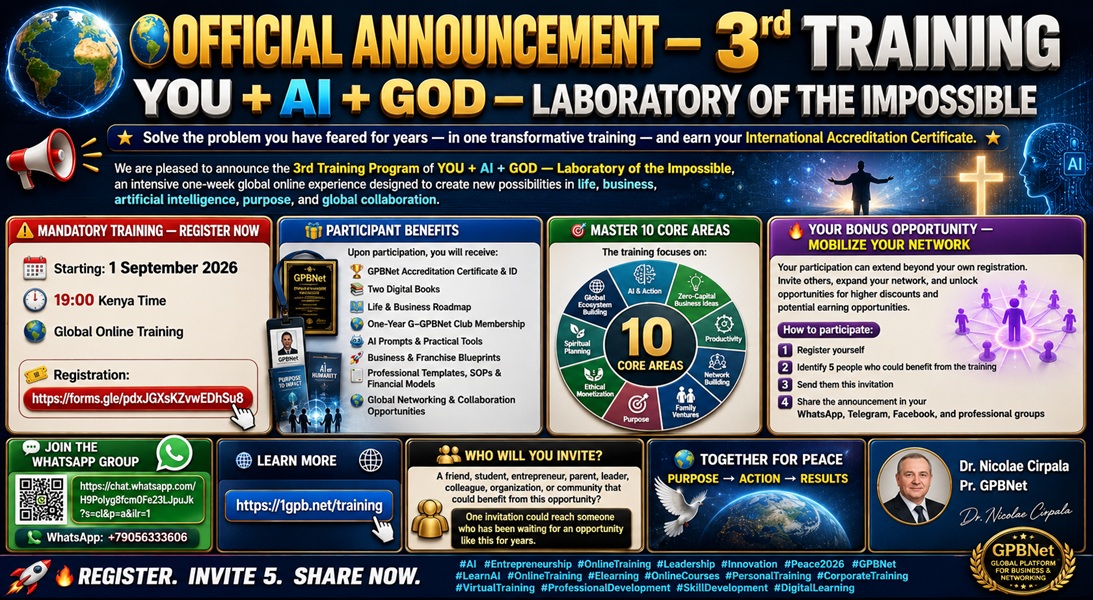
Cîrpala described artificial intelligence as a powerful new instrument—metaphorically calling AI “angels on earth”—that can help people explore options, learn new methods, and improve practical decisions. He paired AI with personal purpose and spiritual reflection in the GPBNet training concept “You + AI + God.” A farmer, for example, could compare modern agricultural techniques and expert recommendations while also reflecting, praying, and drawing on local knowledge before deciding when and how to plant or harvest.
The model does not ask people to surrender judgement to a machine. Its intended sequence is: define a meaningful goal; use AI to explore and compare options; apply ethical and spiritual reflection; test ideas in the real world; learn from results; and share effective practices. GPBNet presented this as a new way to connect technology with human creativity, responsible entrepreneurship, and service.
Why the Summit calls for daily peacebuilding
The keynote criticized a public culture in which media coverage is concentrated just on threats, conflict, and predictions of catastrophe while offering too little practical instruction on how people can improve family relationships, develop livelihoods, protect children, resolve disputes, or start community projects. The proposed alternative is solutions-oriented media that documents effective practices and makes them easier for other communities to replicate.
The speaker also challenged a system in which the public may feel powerless while political and military decisions are made far from everyday life. He argued that digital communication and e-government create more daily channels for citizens to contact elected officials, request accountability, offer constructive proposals, and work with public institutions toward clear shared goals. Such engagement is lawful, courteous, evidence-based, and respectful of democratic processes.
GPBNet’s proposed disruption is to move from reactive crisis management to proactive and, where credible evidence permits, predictive peacebuilding; from occasional summits to daily action; from elite-only diplomacy to broad participation; from conflict-amplifying media to solutions journalism; from youth as spectators and problem makers to youth as leaders and entrepreneurs; and from isolated charitable campaigns to unified sustainable services supported by ethical local enterprise.
A hybrid summit and a declaration for practical action
The Summit’s programme positioned the EPIC 8G format as a bridge between high-level dialogue and local implementation. It invited leaders and representatives to consider four daily questions: What does peace mean for your country? What is the greatest challenge to peace today? What practical action can your country contribute? How can countries cooperate toward Ultimate Global Peace?
The Peace2026 Declaration was presented as a shared commitment to translate principles into practical work. The Summit materials identify the following commitments as its core themes:
- Peace over conflict; dialogue over division; cooperation over isolation.
- Service over selfishness, with human dignity and respect at the centre.
- Education for peace and meaningful participation by young people.
- Responsible leadership, ethical business, and interfaith cooperation.
- Responsible technology and the use of digital tools for positive social impact.
- Practical daily peacebuilding, supported by international partnerships.
- Turning international commitments into unifying local projects with clear responsibilities and evidence of progress.
Summit concluded with the signing of a declaration for Ultimate Global Peace 2026.
The 8G proposal for every country to hosts 8G summits, every community builds a model
GPBNet proposed that every country organize an 8G summit, then connect the outcomes to a network of local and national action teams. The model is not intended to replace governments, existing peace organizations, or formal diplomatic processes. Its proposition is to create a practical cooperation unifying layer that brings them together with sectors that often work separately.
|
8G pillar |
Who it connects |
Purpose |
|
Leaders for Peace |
Government, elected leaders, mayors, public institutions and diplomacy |
Leadership dialogue, accountable cooperation and practical peace initiatives |
|
Business for Peace |
Entrepreneurs, companies, investors and professional networks |
Ethical prosperity, jobs, innovation and support for community services |
|
Media, Culture & Arts |
Journalists, creators, broadcasters and cultural organizations |
Solutions-oriented storytelling and public participation |
|
Peace Education |
Schools, universities, educators and researchers |
Peace literacy, conflict transformation and leadership skills |
|
Youth for Peace |
Young people, volunteers, clubs and internship networks |
Youth leadership, skills, service, ecology, sports and global exchange |
|
Organizations for Peace |
NGOs, charities and civil society |
Coordination, shared projects and reduced duplication |
|
Faith for Peace |
Faith leaders, spiritual communities and interfaith groups |
Dialogue, mutual respect, spiritual practice and joint service |
|
AI, Digital Tools & GCoin for Peace |
Technology, innovators and digital communities |
Responsible digital cooperation, learning, transparency and measurable action |
The Summit’s competition concept invites countries and communities to compare progress—not by the scale of military power, but by the quality and consistency of practical peacebuilding. GPBNet invite participants to publish transparent indicators such as active cross-sector partnerships, youth participation, peace education delivered, volunteer hours, child-protection and environmental projects, disputes addressed through non-violent methods, and projects sustained over time.
Seven GPBNet Model Peace Community platforms
1. Peace Chamber of Commerce — business for peace
This platform is designed to connect business owners, lawyers, AI and IT specialists, agriculture, ocean stewardship, inventors, and aerospace or space-related initiatives. The proposal is to make ethical enterprise a contributor to peace and prosperity: companies can create employment, adopt responsible practices, support local services, and redirect a portion of their resources toward Model Peace Communities. Suggested areas include AI for public-interest applications, transparent governance tools, food security, regenerative farming, ocean protection, and peaceful international scientific cooperation.
2. Peace Academy — education for peace
The Peace Academy aims to connect schools, universities, educators, and researchers. Its proposed curriculum combines living for the sake of others, family-centred values, emotional intelligence, conflict transformation, practical peacebuilding, ethical entrepreneurship, and responsible technology. Teacher networks would share effective lesson plans and examples of Model Peace Schools. Research should remain open to evidence and clearly distinguish empirical findings from theological interpretation.
3. Youth Peace Club — youth, skills, and global village
The Youth Peace Club is intended to make young people active contributors rather than an audience for adult decisions. Its programme areas include volunteering, internships, ecology, sports, hobbies, wellness, travel, creative expression, business incubators and global exchange. The #PeacePictures programme invites children and young people to express their vision of peace through drawings, poems, essays, and digital media. Service projects can include clean-ups, tree planting, food distribution, interfaith activities, and mentoring. G Franchises are proposed as pathways into leadership, media, business, and diplomacy, with appropriate safeguarding and age-appropriate support.
4. God’s Peace Temple — faith and interfaith cooperation
This platform brings together faith leaders and spiritual communities around interfaith dialogue, spirituality, and future-oriented reflection. The presentation cited shared themes across traditions: peacemaking, turning swords into ploughshares, inclining toward peace, inner harmony, and service to others. GPBNet proposes to connect prayer and spiritual practice with concrete community service, while respecting freedom of conscience and the equal dignity of people of different beliefs.
5. Daniil Foundation for Peace — children, families, and social care
Established in 2023 in memory of Daniil Cîrpala, the Foundation is a platform for social services, charity, health, and support for children and families. Proposed projects include providing sustainable land for food cultivation to support orphanages; connecting orphanages with schools for educational and cultural exchange; and expanding #PeacePictures. The presentation calls attention to children affected by displacement, conflict, street homelessness, orphanhood, and disability. All programmes should use responsible safeguarding, verified partner organizations, transparent funding, and clear reporting of outcomes.
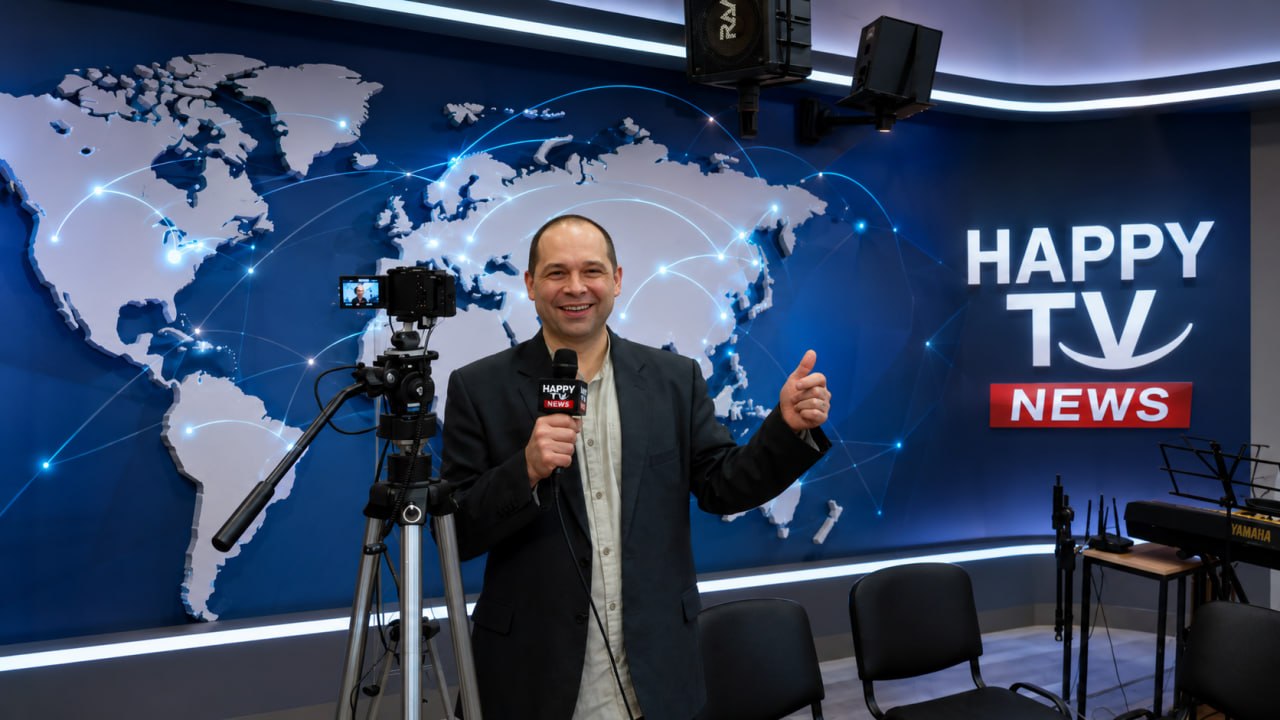
6. Happy TV — media, culture, and arts for peace
Happy TV is intended to unite organizations and communities through media, culture, and the arts. Its proposed editorial approach prioritizes documented community solutions, peacebuilding practice, humanitarian service, positive examples, education, and constructive public dialogue—not the concealment of suffering, but a more balanced account that also shows what works. The network’s listed channels are intended to distribute interviews, training, daily action stories, ambassador recognition, and cross-border collaboration.
7. Peace Party — leaders’ association for peace
The Peace Party concept is described as an association to bring together leaders across political and institutional differences so that competition does not prevent practical cooperation. GPBNet proposes recognizing local leaders—including mayors, educators, businesspeople, parliamentarians, youth leaders, and community representatives—and building local “Dream Teams” with defined roles for representation, mobilization, media, and operations for daily peace actions to build model peace communities. The materials also propose courteous digital letters to public officials and routine citizen feedback through e-government portals. These activities should be non-partisan, transparent, lawful, and respectful of institutions.
The G Franchise model: local action with sustainable operating capacity
GPBNet’s G Franchise concept is a proposed local hybrid of business, service, education, media, and peacebuilding. It is designed to help communities establish a recognizable structure, train volunteers, generate ethical income, create employment, and support practical projects. The model is intended to be adaptable: a G Franchise could be an enterprise, association, school initiative, faith-based project, community organization, or another locally appropriate structure.
The keynote gave the example of a service business that charges clients who can pay and uses a portion of its income to provide free or subsidized services to people with fewer resources. The broader principle is that peacebuilding need not depend entirely on short-term campaigns or donations; responsible local enterprise can help sustain services when financial arrangements are transparent and the model is appropriate to the community.
Children and the environment: vital test of responsibility to future generations
The Summit challenged leaders and citizens to assess their choices through the lives that children will inherit. The presentation highlighted conflict exposure, displacement, children without stable family care, disability, and street homelessness. It also argued that war and militarization consume resources and cause long-lasting environmental harm. The proposed response links child protection with safe learning, nutrition, family support, mentoring, disability inclusion, and community-level safeguarding.
GPBNet’s environmental proposal calls for recurring practical projects: clean-ups, tree planting, ocean stewardship, reuse and recycling, and circular-economy initiatives that create local value. These are actions that communities can begin without waiting for a global treaty, while also advocating for broader changes in policy and resource allocation.
Daily actions: from a global vision to a practical routine
The Summit invited participants to become “spiritual diplomats” by combining reflection and purpose with consistent action. The proposed daily and weekly practices include:
- Carry out one concrete act of kindness: reconcile, help a neighbour, support a family, or serve someone in need.
- Share a verified peacebuilding example through personal or organizational media, using campaign messages such as #Peace2026 and #AllWarsCease2026.
- Contact public representatives through lawful, courteous, evidence-based channels with constructive proposals and requests for accountability.
- Register or connect with a local GPBNet team, identify a practical project, assign responsibilities, and report progress.
- Support child-focused projects through volunteering, partnerships, transparent donations, school connections, or #PeacePictures.
- Use AI to compare options and improve planning, while checking information, protecting privacy, and retaining human responsibility for decisions.
- Record actions and results so that other communities can learn from what works.
“I will act for peace. I will build peace. I will help others. I will connect people. I will contribute to a peaceful world daily.”
— Global Action Moment, EPIC 8G Summit
Korea, spiritual renewal, and the call to a global culture of peace
The keynote described Korea as a place of particular spiritual significance within GPBNet’s faith perspective. It referred to the 1907 Pyongyang Revival, Korea’s post-war development, advances in semiconductors and emerging technologies, and the 2025 Cheon Won Gung ceremony as parts of a wider narrative of spiritual renewal and human development. The speaker presented peaceful reunification of the Korean Peninsula as a hoped-for contribution to global peace. The practical Summit proposal is to encourage cooperation, reconciliation, education, and peaceful dialogue.
The presentation also discussed daily prayer and meditation as practices that support personal calm, empathy, and social connection. The Summit’s proposal is to treat voluntary daily spiritual practices as devotional capital a complement to—not a substitute for—evidence-based conflict prevention, mental-health support, diplomacy, and community service.
The “Release the Mother of Peace — All Wars Cease 2026” appeal
The Summit call for a non-violent public campaign supporting the release of Holy Mother Han, the Mother of Peace and a nominee for the 2026 Nobel Peace Prize. The campaign asks to contact the President of the Republic of Korea through diplomatic and humanitarian channels, organize peaceful gatherings and open letters, communicate with news organizations, and join the Global Prayers Chain.
GPBNet’s campaign message links the appeal to the wider objective of ending wars in 2026. The Summit’s operational emphasis is on lawful advocacy, dialogue, humanitarian protection, daily peacebuilding, and the creation of model communities that demonstrate cooperation in practice.
International recognition and awarding ceremony
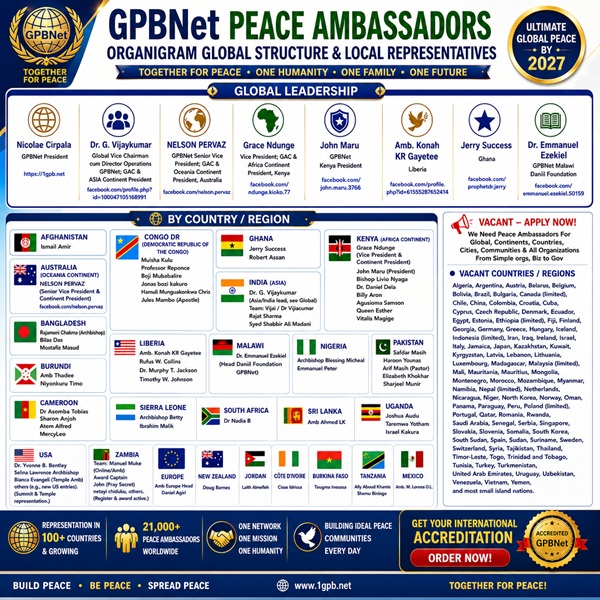
The Summit recognized as global peace ambassadors following distinguished people.
- Yesim Oruc — UN Resident Coordinator in Moldova.
- Peter Pellegrini — President of the Slovak Republic.
- Myles Geiran — Ambassador of Ireland to Moldova.
- E. Faisal Niaz Tirmizi — Ambassador of the Islamic Republic of Pakistan
- Marija Kapitanović — Ambassador Extraordinary and Plenipotentiary of Croatia
- Jacek Kasprzyk — Chargé d’affaires a.i. of Poland to Moldova.
- E. Ivan Vangu Ngimbi — Ambassador of the Democratic Republic of the Congo
- E. Pericles Stivaros — Ambassador of the Republic of Cyprus.
- Cristian-Leon Țurcanu — Ambassador Extraordinary and Plenipotentiary of Romania to the Republic of Moldova.
- Brendan Ward — Ambassador of Ireland to Romania.
- Abdulhadi Al-Hawaij — Minister of Foreign Affairs and International Cooperation.
- Ambassador Nelson Pervaz — GPBNet Senior Vice President and GAC & Oceania Continent President, Australia.
- Ambassador Selina Lawrence —GPBNet ambassador.
- Grace Ndunge — GPBNet Vice President and GAC & Africa Continent President, Kenya.
- Samuel Karanja Mwan.
- Ambassador Apostol Jane N. Ngondo.
- Serah Wayua Nzau.
- Faith Neema Ndunda.
- Ambassador Catherine N. Kimani.
- Ambassador Anne W. Mwaura.
- Ambassador Patricia M. Kitili.
A Message from Ambassador Nelson Pervaz
In his address, Nelson Pervaz congratulated GPBNet and Nicolae Cîrpala on organizing the Summit and emphasized multicultural, multilingual, multi-faith, inter-religious, and inter-denominational cooperation. He expressed gratitude for the efforts of peace ambassadors and prayed for people living through war, for the sick, and for peace, unity, healing, and reconciliation across countries.
Pervaz spoke in support of Holy Mother Han and called for prayer for her health, release, and freedom. Reflecting on his visit to South Korea, he referred to religious gatherings, marriage blessings, the Sunhak Peace Prize ceremony, and an inter-parliamentary speakers’ conference as examples of international engagement and dialogue. He concluded that peace cannot be the work of one individual alone: people must work together, respect others regardless of faith or belief, and live for the sake of others.
“God made all of us one family, and we are one family under God. We should work for the sake of others.”
— Ambassador Nelson Pervaz
The speaker closed with prayers and good wishes for Australia, Moldova, Africa, Russia, and the world, and expressed hope to visit Moldova in the future.
A competition between countries and communities: measure what is built, not only what is promised
GPBNet proposed a constructive international comparison in which countries, cities, schools, businesses, faith communities, youth groups, and civil-society organizations can demonstrate how they turn peace commitments into sustained work. The intention is not to rank the worth of nations or communities, but to make good practice visible, encourage learning, and reward verifiable progress.
|
Suggested indicator |
Evidence to publish |
Why it matters |
|
Local peace teams |
Named team, roles, meeting cadence and public contact channel |
Shows that a commitment has an operating structure |
|
Cross-sector partnerships |
Signed collaboration notes, joint events and shared project plans |
Reduces duplication and builds trust across sectors |
|
Youth opportunity |
Youth-led projects, internships, training hours and safeguarding policy |
Turns young people into contributors with practical pathways |
|
Peace education |
Schools or groups reached, lessons delivered, educator participation |
Builds durable skills for dialogue and conflict transformation |
|
Child and family support |
Verified partner institutions, services delivered and follow-up |
Connects peacebuilding to the protection of children and families |
|
Environmental action |
Clean-up, tree-planting, recycling or ocean-care records and follow-up |
Makes responsibility for the shared environment tangible |
|
Ethical local enterprise |
Jobs, services, transparent community contributions and governance |
Links prosperity to local resilience and social benefit |
|
Media for peace |
Published solutions stories, source links, corrections and audience reach |
Makes constructive practices visible without hiding hard realities |
|
Responsible technology |
AI-use policy, privacy safeguards, verified projects and outcomes |
Encourages innovation with accountability |
|
Sustained outcomes |
Baseline, target, periodic update and independent evidence where feasible |
Distinguishes ongoing results from one-time publicity |
Countries could host periodic 8G summit, publish a public action plan, nominate local project teams, and report progress on a shared calendar. Communities could learn from one another through case studies, peer review, and exchanges. Any awards or rankings should use transparent criteria, accessible evidence, conflict-of-interest safeguards, and a process for correcting errors.
Official channels and proposed distribution
The Summit materials identify the following GPBNet channels for publication, follow-up, and international cooperation.
- GPBNet website: https://1gpb.net
- Facebook: https://facebook.com/GPBNet
- YouTube / Happy TV News: https://youtube.com/happytvnews
- LinkedIn: https://linkedin.com/in/nicolaecirpala
- Threads: https://threads.net/@happy_tv_news
- X: https://x.com/cirpalanicolae
- TikTok: https://tiktok.com/@happytvnews
- Instagram: https://instagram.com/happy_tv_news
- Spotify / Happy TV: https://open.spotify.com/show/2nEpMW6S2lkSdnE8hviKfL
- Blog: https://ucmd1.blogspot.com
Closing statement
In his closing message, Nicolae Cîrpala invited every person—whether a public official, entrepreneur, teacher, parent, student, faith leader, journalist, volunteer, or community organizer—to see themselves as capable of contributing to history. The invitation is to move beyond waiting for a single leader or institution to deliver peace and finance but to begin building practical cooperation in families, neighbourhoods, workplaces, schools, businesses, faith communities, and public life.
“One world. One peace. One future.”
— EPIC 8G Summit closing theme
GPBNet’s message is that a peaceful future requires both a unifying vision and a practical method: people connected across borders, daily service, responsible leadership, education, ethical enterprise, child protection, environmental care, faith and dialogue, positive media, and technology used in the public interest. The Summit called for the same commitment to be repeated in every country and translated into action that can be seen, evaluated, and improved.
“Children of God of all countries, unite. Together for Ultimate Global peace.”
Nicolae Cîrpala
Investigative Journalist at Happy TV News & President, Global Peace Building Network (GPBNet)
Website: https://1gpb.net
Source notes
Publicly sourced context used in this report:
- Uppsala Conflict Data Program (UCDP), 2025 data page: https://ucdp.uu.se/year/2025 — reports 65 state-involved conflicts and approximately 245,681 deaths across organized-violence categories in 2025. The UCDP page breaks this total into state-based violence, non-state violence, and one-sided violence.
- Institute for Economics & Peace, Global Peace Index 2026 report: https://www.visionofhumanity.org/wp-content/uploads/2026/06/Global-Peace-Index-2026-Report.pdf — reports that 103 countries were involved in at least one external conflict in the preceding five years.
- UNICEF Data, Child Displacement and Refugees: https://data.unicef.org/topic/child-migration-and-displacement/displacement/ — reports 48.8 million children displaced by conflict and violence by the end of 2024.
- UNICEF, 28 December 2024, “Not the new normal”: https://www.unicef.org/mena/press-releases/not-new-normal-2024-one-worst-years-unicefs-history-children-conflict — reports that over 473 million children lived in areas affected by conflict in 2024.